

About Us
Rooted in Practice.
ĀTMĀ was created from a simple belief: yoga can be both accessible and deeply rooted.
Over time, yoga has been expressed in many ways, by many teachers, and through many traditions. While approaches may differ and resonate with different people, we welcome all kinds of new students while continuing to support those seeking a deeper relationship with yoga.
ĀTMĀ was founded to create space for that kind of practice. A space where movement, breathwork, meditation, study, and self-study can exist alongside one another. A space that welcomes both new and experienced practitioners while keeping depth, curiosity, and respect for tradition.
We also believe it is possible to create a more sustainable model for yoga, one that supports accessibility for students while creating meaningful opportunities for teachers to grow, teach, and continue their own practice.
At its core, ĀTMĀ is built on a constructive belief that another approach is possible: one that values accessibility and depth, tradition and openness, individual practice and shared learning, and the long-term sustainability of both students and teachers.
What we believe
-
Yoga encompasses a rich tradition of practices, teachings, and approaches that have been explored, refined, and transmitted through diverse traditions over time. Across lineages, texts, and traditions, practitioners have engaged with yoga through a variety of complementary paths and practices.
At ĀTMĀ, we view movement (āsana), breathwork and prāṇāyāma, meditation (dhyāna), and self-study (svādhyāya) as interconnected aspects of practice. While these elements are often presented individually, they can also support and inform one another as part of a broader relationship with yoga.
Some students may feel drawn more strongly to movement, while others may find themselves exploring meditation, philosophy, prāṇāyāma, Sanskrit, or self-study. There is no expectation that every practitioner engage with every aspect of practice in the same way or at the same time.
ĀTMĀ exists both as a place for exploration and as a home for practitioners seeking opportunities to engage with the broader traditions of yoga. Through classes, study, independent practice, and our monthly Stories of Yoga evenings, we aim to create space for those experiences while honoring the traditions from which they emerged.
-
ĀTMĀ was founded on the belief that accessibility and sustainability belong together.
For students, accessibility means creating opportunities to engage with yoga in ways that feel welcoming, approachable, and supportive of long-term practice. For teachers, sustainability means creating conditions that support continued learning, thoughtful teaching, and the ability to remain engaged in the work over time.
A healthy yoga community depends on both. When students have meaningful access to practice and teachers have opportunities to grow and sustain their work, the entire community benefits.
This belief informs how ĀTMĀ approaches programming, education, partnerships, and the ongoing development of the studio. We aim to support a practice environment that values both students and teachers, both accessibility and depth, and both tradition and continued growth.
-
While practice is deeply personal, it has rarely existed in isolation.
Yoga has long been studied, practiced, and transmitted through relationships between teachers and students, within lineages, and alongside fellow practitioners. Those relationships continue to shape how knowledge, experience, and practice are shared today.
At ĀTMĀ, we aim to create opportunities for both. Space for personal exploration and reflection, alongside opportunities to learn, practice, and grow together.
Whether through class, study, conversation, or simply sharing a room dedicated to practice, these experiences contribute to the broader culture of learning that has long been part of yoga.
Our role is to make space for practice, study, exploration, and reflection. What connects practitioners isn't always the same goals or beliefs, but the practice itself. What you discover through your practice is your own.
Practice With Us.
The studio
-
Āsana, prāṇāyāma and meditation, in structured classes through the week. As a traditionally rooted studio, we treat them as parts of one practice: posture, breath and stillness, each given its time. The schedule includes vinyāsa, haṭha, slow flow, yin, restorative and sound (so far), and each teacher draws on their own training, practice and continuing study.
Each month, Stories of Yoga with Monisa brings yoga's teachings into the room through story and practice, and the Sunday Sound Bath with Seema opens the week with an hour of stillness. Seasonal workshops are added through the year.
-
The studio is on the third floor of 66 Hudson Street, Suite 3F, steps from the waterfront and minutes from Hoboken Terminal. There's no elevator.
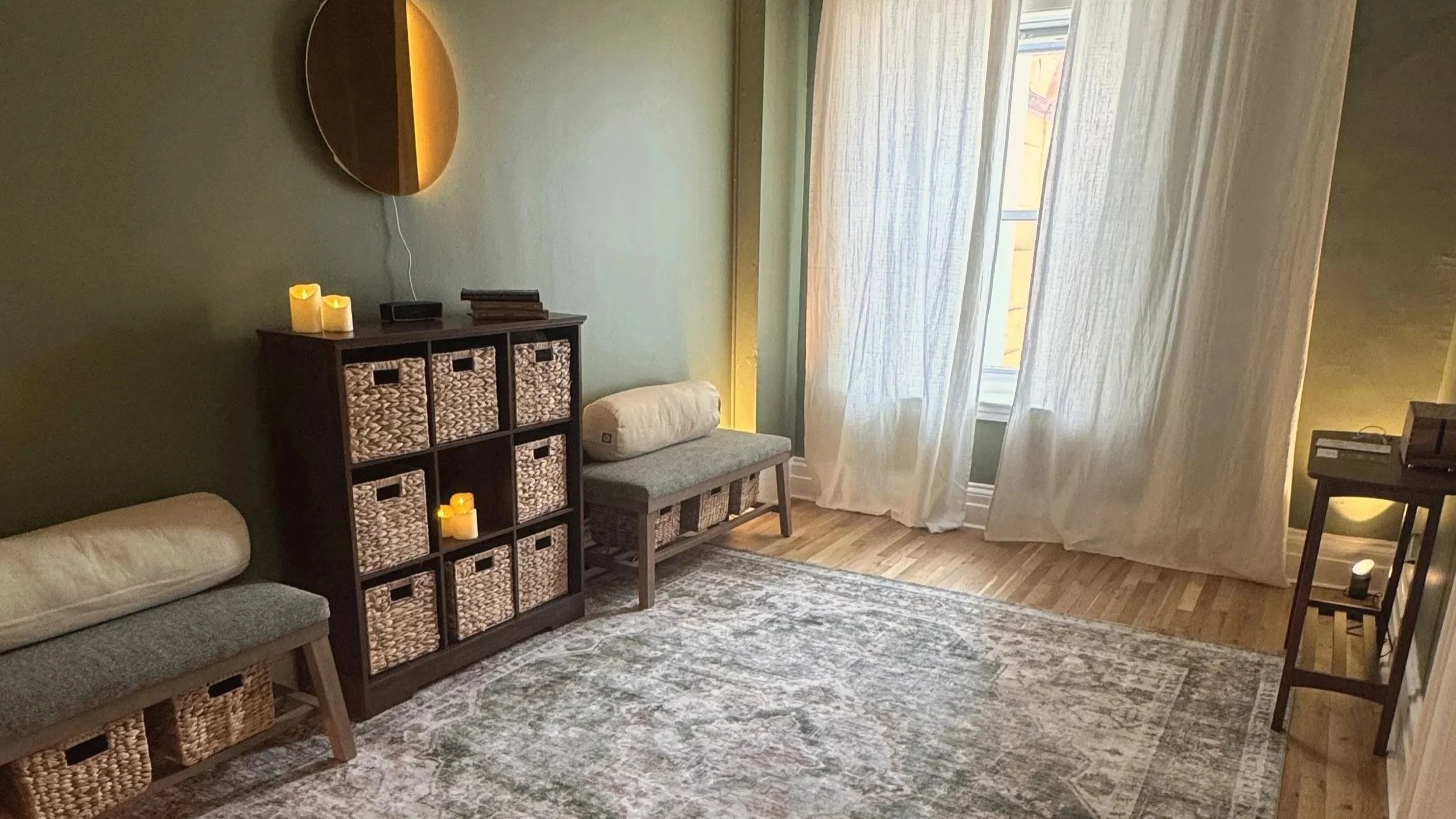
Coming up from the street, the city drops away. Inside, fourteen-foot ceilings rise over exposed brick, and the bay windows look out to the Lackawanna clock tower with the Manhattan skyline beyond it. The palette is earthy, the light is soft, and evening classes are lit low with lamps and candlelight. It's a room that invites you to slow down before class has even begun.
The main room holds group classes, and a smaller private room is used for one-on-one sessions. Mats are from KOSHA; bolsters, straps and blankets are from Yogikuti; and the natural cork blocks are from Everyday Yoga, with enough of everything for a full class. You're always welcome to bring your own mat. There's a water station with hot, cold and room-temperature water. The studio is shoe-free. Leave your shoes, and the day, at the entrance; socks are welcome.
-
Nothing here is starting over. What you practiced before comes with you. Coming back to the practice is part of the practice.
There's more than one way back in. If you'd rather move at your own pace, members have Open Practice hours each week: the room, the props and the quiet, for your own personal practice. If you're looking for a teacher, the schedule spans a range of teaching styles and traditions, so you can try a few classes and find someone you connect with. Foundations, on Tuesdays at 6:00 PM, is a steady place to start again, and every class offers modifications throughout.
-
Because ĀTMĀ is a collective of teachers, each bringing a practice of their own. The studio was founded to honor yoga's traditions, to put human connection first, and to give teachers room to teach from their own study and experience. There are no studio scripts or set sequences; each teacher designs their own classes and finds their own voice in the room.
The same idea shapes how the studio runs: pricing that makes regular practice possible, and a model built to make teaching sustainable. That's what "collective" means here: teachers and practitioners sharing a room, held together by the practice.
Meet the teachers on the Teaching Partners page.
-
Chandler Lennon is ĀTMĀ's founder and teacher. He has practiced yoga for fourteen years, much of that alongside a career in the corporate world. In that time he struggled to find a studio he really resonated with as a student, much less as a teacher. When the right space came up at 66 Hudson Street, opportunity met the right timing, and ĀTMĀ opened in July 2026.
He started it with two connected aims: to make yoga more accessible and affordable for the people who practice, and more sustainable and equitable for the people who teach. He still runs the studio day to day, and he teaches.
Outside the room, he's teaching himself Sanskrit and working through yoga's classical texts, which mostly means more evenings with a dictionary than he'd care to admit. He lives in Jersey City with his partner, Rich, and their dog, Murphy, and still finds time to bake.
-
ĀTMĀ (आत्मा) — Sanskrit for "self," often understood as the true or essential Self. It's pronounced AHT-mah.
The word has been understood in different ways across Indian philosophy and the wider traditions of South Asia, and we don't claim one interpretation as ours. We chose it for the direction it points: inward. Moving through the body and settling the breath clears enough room to notice what sits underneath the day, and steadiness in the body is what makes stillness available to the mind.
Every class here leads in that direction, whether it's a strong vinyāsa, an hour of yin or a few quiet minutes of meditation. Teachers provide structure and guidance; each practitioner's experience remains their own. The name is a reminder of what practice makes time for: slowing down, breathing, and turning inward to know yourself more clearly.
-
ĀTMĀ is independent and isn't affiliated with any single lineage, school or brand. Our teachers have trained in different methods and traditions, from haṭha and vinyāsa to yin, restorative practice, meditation and sound, and each teaches from their own training.
A key basis for how we think about practice comes from two lines of Patañjali's Yoga Sūtras (2.46–2.47):
sthira-sukham āsanam
prayatna-śaithilya-ananta-samāpattibhyām
Posture is steady and at ease, arising through the relaxing of effort and absorption in the infinite.
We hold it as an orientation, not a rule: steadiness without strain, and ease without losing attention.
The work is individual; the room is shared.